Workflow Types
The Three Generalized Workflows
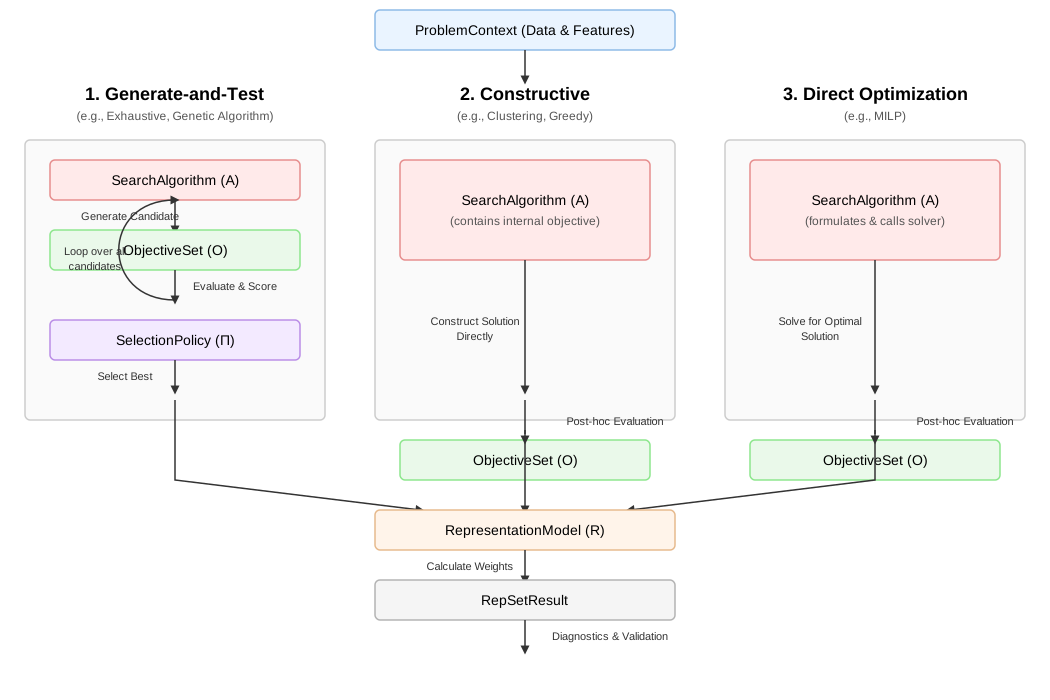
Here are the three primary types of workflows that energy-repset supports. Each uses the five core modules in a slightly different sequence and with different emphasis.
Workflow 1: Generate-and-Test
This is the classic combinatorial search approach. Its philosophy is to create many candidate solutions, evaluate each one thoroughly, and then use a clear policy to select the best.
- Status: Fully implemented in the current software.
- Examples: Exhaustive (brute-force) search, Genetic Algorithms.
- How the Modules are Used:
- SearchAlgorithm (A): Its main role is to generate candidate subsets. This is often delegated to a CombinationGenerator (which can handle constraints like "one per season").
- ObjectiveSet (O): Used intensively. It is called to evaluate every single candidate subset generated by the search algorithm.
- SelectionPolicy (Pi): Used at the very end. After the search is complete, it receives a full table of all candidates and their scores, and applies its rule (e.g., WeightedSum) to pick the winner.
- Summary: There is a clear, linear sequence: the SearchAlgorithm generates, the ObjectiveSet evaluates, and the Policy decides.
Key Modules:
| Role | Implementation | Import |
|---|---|---|
| Search | ObjectiveDrivenCombinatorialSearchAlgorithm |
energy_repset.search_algorithms |
| Candidates | ExhaustiveCombiGen, GroupQuotaCombiGen, hierarchical variants |
energy_repset.combi_gens |
| Evaluation | ObjectiveSet with ScoreComponent instances |
energy_repset.objectives |
| Decision | WeightedSumPolicy, ParetoMaxMinStrategy, ParetoUtopiaPolicy |
energy_repset.selection_policies |
Examples: Ex1: Getting Started, Ex2: Feature Space, Ex3: Hierarchical Selection, Ex4: Representation Models, Ex5: Multi-Objective
Workflow 2: Constructive
This approach builds a solution directly and iteratively, rather than testing pre-made combinations. It's generally much faster than the Generate-and-Test workflow.
- Status: Implemented. Three constructive algorithms are available.
- Examples: Hull Clustering, CTPC (Chronological Time-Period Clustering), Snippet Algorithm.
- How the Modules are Used:
- SearchAlgorithm (A): This is the star of the show. It contains the entire complex logic of the method (e.g., the k-medoids algorithm). It has its own internal objective (e.g., minimize intra-cluster distance) that guides its construction process.
- ObjectiveSet (O): Not used during the search. Its role shifts to post-hoc evaluation. After the SearchAlgorithm has constructed a final solution, the ObjectiveSet is used to give it a standardized score. This is crucial for comparing its result against the results from other workflow types.
- SelectionPolicy (Pi): Bypassed entirely. The constructive nature of the algorithm is its own policy; the final result is the direct output of the construction process, with no separate decision step needed.
- Summary: The SearchAlgorithm does all the heavy lifting to directly build a solution. The ObjectiveSet is only used for final validation.
Key Modules:
| Role | Implementation | Import |
|---|---|---|
| Search | HullClusteringSearch |
energy_repset.search_algorithms |
| Search | CTPCSearch |
energy_repset.search_algorithms |
| Search | SnippetSearch |
energy_repset.search_algorithms |
| Protocol | SearchAlgorithm (structural typing) |
energy_repset.search_algorithms |
| Evaluation | ObjectiveSet (post-hoc only) |
energy_repset.objectives |
Examples: Ex6: K-Medoids Clustering and Ex7: Constructive Algorithms
For algorithm details, see Constructive Algorithms.
Workflow 3: Direct Optimization
This is the most sophisticated workflow. It formulates the entire selection problem as a single, large-scale mathematical optimization problem and uses a dedicated solver to find the globally optimal solution.
- Status: Not yet implemented in the current software.
- Examples: Mixed-Integer Linear Programming (MILP) to select periods that best reconstruct an annual duration curve.
- How the Modules are Used:
- SearchAlgorithm (A): Its main job is to act as a bridge to a mathematical programming solver (e.g., Gurobi, HiGHS). It translates the user's problem into the strict mathematical language of the solver.
- ObjectiveSet (O): Its concepts (e.g., "minimize NRMSE") are translated into the formal mathematical objective function of the optimization model. It is deeply embedded within the SearchAlgorithm's formulation.
- SelectionPolicy (Pi): Bypassed entirely. The solver's goal is to find the single optimal solution that minimizes the mathematical objective. The decision is inherent in the optimization process.
- Summary: The problem is handed off to a powerful external solver. The main work is in the formulation of the problem within the SearchAlgorithm module.
Key Modules:
| Role | Implementation | Status |
|---|---|---|
| Search | MILP-based SearchAlgorithm |
Planned |
| Protocol | SearchAlgorithm (structural typing) |
energy_repset.search_algorithms |
| Solver | External (Gurobi, HiGHS, etc.) | N/A |
Planned algorithms: MILP-based duration curve reconstruction, MILP with temporal coupling constraints.
The Workflow Dataclass
All three workflow types share the same assembly pattern. The Workflow dataclass bundles the three runtime components -- a FeatureEngineer, a SearchAlgorithm, and a RepresentationModel -- into a single object that RepSetExperiment can execute:
import energy_repset as rep

workflow = rep.Workflow(
    feature_engineer=feature_engineer,   # F: transforms raw data into features
    search_algorithm=search_algorithm,   # A: finds optimal selection (uses O internally)
    representation_model=representation_model,  # R: calculates weights
)

experiment = rep.RepSetExperiment(context, workflow)
result = experiment.run()
The Workflow is intentionally thin: it holds references to components, not logic. The orchestration logic lives in RepSetExperiment.run(), which calls the components in sequence. This keeps each component independently testable and swappable.
Practical note on features. Feature normalization and variable weighting are handled within the FeatureEngineer component (F). The choice of F determines what distances and similarities mean for the downstream search: two periods that appear similar under one feature space may look very different under another. See the Configuration Advisor for guidance on normalization and weighting.
For the full component catalog, see Modules & Components.